
|

|
FROM THE CEO'S DESK
|
Welcome to the fourth edition of iFOREST Quarterly!
The final quarter of 2025 was marked by significant
progress across our priority areas, with a strong
focus on air pollution mitigation and clean air
governance. We released the Stubble Burning Status
Report 2025, which challenged assumptions on declining
farm fires, continued our Smog Tales – Season 2
journey through Maharashtra to document worsening
urban air pollution, and supported the launch of the
Guwahati Clean Air Plan to strengthen coordinated
urban air management.
Our work also advanced climate governance, just
transition, and sustainable industry. We released the
report ‘Strengthening State Climate Action Framework:
Translating Ambition into Action’ and continued
institutional capacity building through the National
Clean Air Programme regional training with ICIMOD.
Internationally, we contributed to global policy
dialogue at MOP37 and engaged with leaders at the
Global Energy Leaders Summit in Puri to emphasise the
need for accelerated electrification.
This quarter also strengthened our work on just
transition and green growth, including the launch of
India’s first Climate Change and Just Transition Forum
at the Odisha Vikash Conclave, the release of our
study on Odisha’s green workforce, and a landmark
report on repurposing coal mining land in Jharkhand
for green industry. Meanwhile, our Green Steel
programme continued advancing ESG readiness and
climate transparency across the sector.
We look forward to launching the Ratnagiri District
Development-cum-Climate Action Plan, outlining
actionable, sector-wise strategies to mainstream
climate resilience into district governance and
implementation.
Thank you for your continued trust and support as we
work together toward a sustainable future. That was
our 2025 at iFOREST—with big moments, big shifts and a
team that kept us going. See you in 2026!
Thank you for your continued support.
Sincerely,
Chandra Bhushan
President & CEO
iFOREST
|
|
|
-
In a warming world, thermal comfort is no longer optional.
It intersects with health, education, and productivity,
writes senior research associate Shri Nidhi Gowthaman in an
iFOREST blog.
-
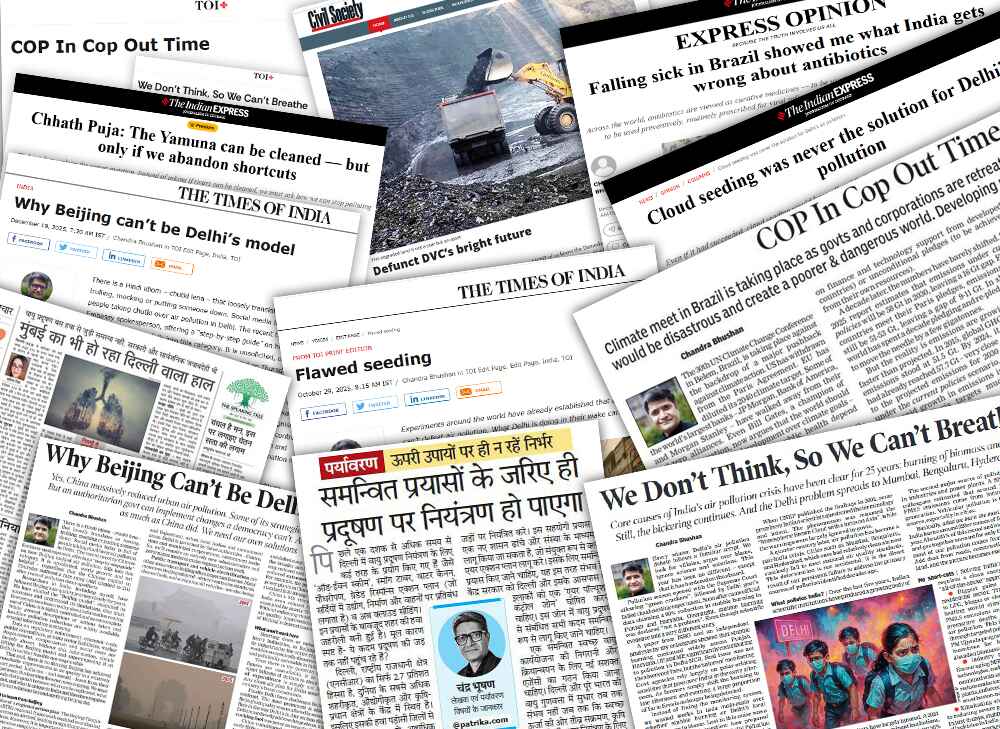
The Yamuna can be cleaned — but only if we abandon
shortcuts, writes Chandra Bhushan in
Indian Express
along with co-authors Manoj Kumar Singh (former Chief
Secretary of Uttar Pradesh) and Akhilesh Gautam (Former UN
Specialist in WASH).
-
Delhi’s air will not improve through gimmicks like cloud
seeding or water cannons—it requires a regional airshed
approach, writes Chandra Bhushan in the
Times of India.
-
Cloud seeding was never the solution for Delhi’s air
pollution, writes Pratima Singh, in the
Indian Express.,
-
The Damodar Valley teaches us that transformation cannot be
left to chance — it requires foresight, planning, and
investment, writes Chandra Bhushan in the
Civil Society.
-
For developing countries, climate action is not a moral
burden—it is an opportunity to drive green growth, ensure
energy independence, create millions of new jobs, writes
Chandra Bhushan in the
Times of India.
-
The climate crisis has outgrown the UNFCCC system. It now
demands rapid implementation and hard political choices,
writes Chandra Bhushan in
Financial Express.
-
If Delhi is serious about improving air quality, it must
stop relying on ineffective, superficial solutions. The real
solution lies in collaboration between the Central
government and states, writes Chandra Bhushan in the
Civil Society Magazine.
-
Falling sick in Brazil showed me what India gets wrong about
antibiotics, writes Chandra Bhushan in
The Indian Express
on India’s growing antibiotic resistance
-
Solving India’s air pollution crisis requires a clean energy
transition, writes Chandra Bhushan in the
Times Of India
urging for the need to acknowledge the impact and sources of
our pollution crisis.
-
To tackle the pollution crisis India needs it’s own
solutions, writes Chandra Bhushan in
Times Of India,
not a replica of the Beijing model.
-
India needs stronger, modernised environmental standards
including better monitoring, clearer pollution limits, and
regular updates to truly control industrial pollution,” says
Sanjeev K Kanchana, Director, ESG and Industrial
Decarbonisation in his interview for Revolve.
|
Training to Strengthen Clean Air Action, Lucknow

Air pollution remains a growing challenge across South Asia,
demanding stronger local capacity and coordinated action. To
support this effort, iFOREST and ICIMOD hosted the first
regional training under the ‘National Clean Air Programme –
Planning, Implementation & Monitoring’ on ----in Lucknow,
bringing together 31 senior officials from India and Nepal.
The two-day programme focused on city-level clean air
planning, hotspot strategies, digital monitoring tools, and
peer learning, strengthening institutional capacity and
fostering South–South collaboration to advance cleaner,
healthier, and more resilient cities across the Indo-Gangetic
Plain and Himalayan Foothills.
|
iFOREST at Renewable Energy India Expo 2025

On October 31, iFOREST joined GRIDCO Limited as knowledge
partner at the Renewable Energy India Expo 2025 in Greater
Noida, where Odisha—this year’s State Partner—showcased its
renewable energy ambitions toward 10.96 GW by 2030. Mandvi
Singh, Director Clean Energy moderated a session on
‘Accelerating Renewable Integration: Odisha’s Strategic
Vision’, featuring key industry leaders. The discussion
highlighted Odisha’s progressive policies, strong project
pipeline, and growing investor confidence for emerging
renewable energy regions.
|
Global Dialogue on Refrigerant Emissions at MOP37

Refrigerant leakage is fast emerging as one of the most
critical climate risks linked to India’s growing cooling
demand. To advance solutions, iFOREST hosted a side event
titled ‘Addressing the Leak: Findings from India’s Largest
Survey and Policy Gaps in Lifecycle Refrigerant Management
(LRM)’ on November 4, 2025, during MOP37, Nairobi. iFOREST,
shared insights from our first-of-its-kind national survey on
AC use, refrigerant handling, and consumer behaviour.
Discussions highlighted challenges in LRM implementation,
climate-friendly alternatives, and financing models
underpinning the urgent need for systemic reform to curb
refrigerant emissions.
|
Training on National Clean Air Programme

South Asian cities continue to grapple with worsening air
pollution, underscoring the need to strengthen capacity for
clean air planning. To support this, iFOREST and ICIMOD
organised the second regional training under the ‘National
Clean Air Programme – Planning, Implementation & Monitoring’
on 5–6 November in Delhi. The two-day programme brought
together 28 senior officials from Nepal and key Indian states
to build technical and managerial skills for Clean Air Action
Planning, fostering regional learning to advance cleaner,
healthier, and more resilient communities.
|
Strengthening India’s State Climate Action Framework

For over a decade, India’s State Action Plans on Climate
Change (SAPCCs) have guided climate action at the state level
— but progress has often remained uneven due to capacity,
finance, and coordination gaps. On November 7, 2025, iFOREST
released its report ‘Strengthening State Climate Action
Framework: Translating Ambition into Action,’ proposing key
reforms to make SAPCCs more effective, better financed, and
implementation-ready. Drawing on insights from MoEFCC, state
climate cells, and financial institutions, the report charts a
pathway to strengthen climate governance across states and
districts.
|
Training for Mitigating Air Pollution, Mumbai

iFOREST organised a two-day training in Mumbai on 25–26
November for 24 senior officials from Urban Local Bodies
across Maharashtra to strengthen clean air and dust management
practices. The programme featured sessions by regulators,
experts, and civil society organisations, focusing on clean
air planning tools, hotspot strategies, and practical case
studies from Indian cities, along with collaborative learning
and experience-sharing.
|
First comprehensive ESG Benchmarking for Steel Sector

India’s steel industry is central to economic growth, but it
remains one of the most carbon- and resource-intensive
sectors. To support a low-carbon transition, iFOREST launched
a landmark initiative on November 13, benchmarking ESG
performance across Indian steel companies, developing a
sector-specific BRSR supplement, and creating a unified GHG
reporting template aligned with global best practices. These
tools aim to strengthen transparency, disclosure quality, and
climate accountability—positioning the steel sector to lead
India’s green industrial transformation.
|
Advancing People-Centred Climate Action in Odisha

Climate action must deliver both environmental and social
progress—and Odisha is taking important steps in this
direction. At the Odisha Vikash Conclave on November 26, 2025,
iFOREST, CYSD, and partners launched India’s first Climate
Change and Just Transition Forum, alongside announcements on a
Transition Fund and Energy Transition Policy. iFOREST also
released “Building Odisha’s Green Workforce,” reinforcing that
Odisha’s green transition must keep people and equity at its
cor
|
Stocktaking Stubble Burning in 2025

Was the decline in stubble burning real or simply what we were
able to see? iFOREST’s Stubble Burning Status Report 2025,
released during an online webinar on December 8, 2025, reveals
that the reported 90% drop in farm fires in Punjab and Haryana
is largely due to gaps in the current monitoring system, which
fails to detect many fires. Using a first-of-its-kind
multi-satellite assessment, the report shows that a
significant share of large fires goes unrecorded because they
occur outside the satellite observation window.
|
Smog Tales Season-2
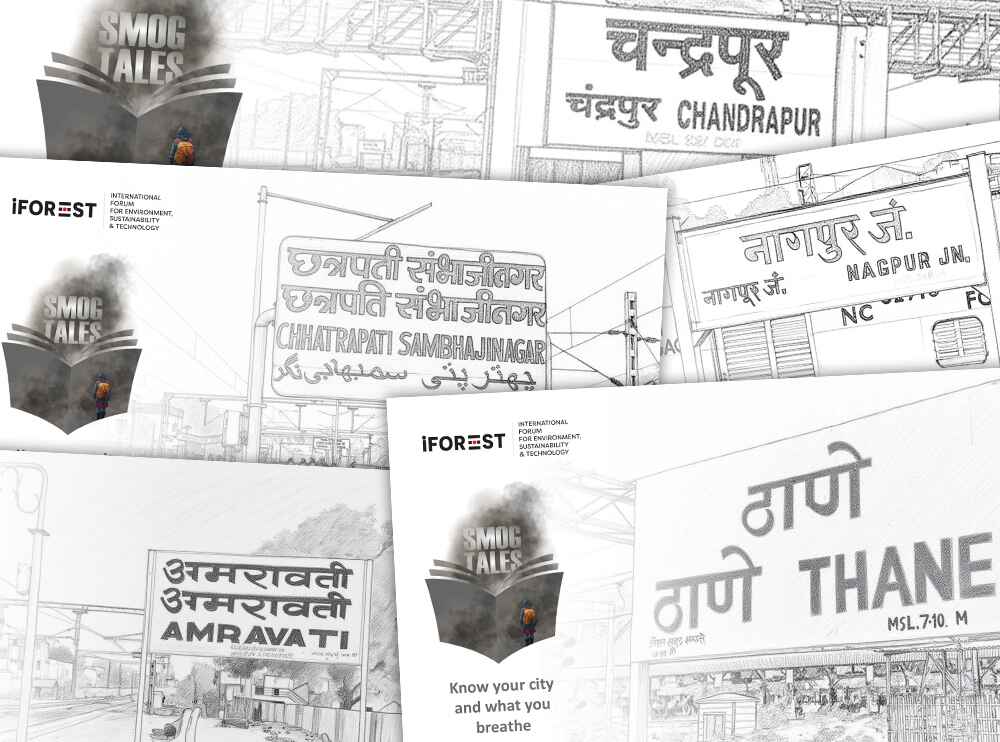
Air pollution is no longer a “Delhi problem” — it’s now
choking cities and communities across India. This year,
iFOREST’s Smog Tales – Season 2 travelled to Maharashtra,
uncovering air pollution status in Thane, Amravati, Nagpur,
Chhatrapati Sambhajinagar and Chandrapur. Through voices from
the ground and expert perspectives, the series revealed how
worsening air quality is affecting health, livelihoods, and
daily life — while calling for urgent, people-centric action
to secure clean air for all.
|
Accelerating India’s Clean Energy Transition

As India advances toward its goal of 500 GW of non-fossil
energy, iFOREST participated in the Global Energy Leaders
Summit 2025 in Puri, where senior leaders discussed pathways
for a secure and sustainable energy future. iFOREST CEO
Chandra Bhushan emphasised the need to accelerate
electrification to boost renewable demand, while key outcomes
included MoUs on renewables and green hydrogen and the Draft
Puri Declaration to strengthen coordinated energy planning.
|
Launching a Roadmap for Cleaner Air in Guwahati

Air pollution is an emerging challenge for fast-growing cities
like Guwahati, demanding coordinated and science-led action.
To support this transition, iFOREST, in partnership with the
Pollution Control Board, Assam, launched the Guwahati Clean
Air Plan on December 17. A comprehensive, sector-wise roadmap
to tackle the city’s key emission sources. The plan sets out a
clear, evidence-based framework for coordinated implementation
across agencies, defining roles, timelines, and priorities
while strengthening policy integration and monitoring to
secure sustained improvements in air quality.
|
Advancing Floating Solar Development in Assam

Assam is uniquely positioned to scale clean energy while
strengthening rural livelihoods. To advance this opportunity,
On December 18, 2025 iFOREST hosted a roundtable on
“Accelerating Solar Deployment on Water Bodies in Assam,” in
Assam bringing together AEDA, APGCL, IIT Guwahati, the
Department of Fisheries, SIDBI, TERI, WRI, Guwahati
University, and other experts. Discussions emphasized the
promise of decentralised, livelihood-linked FSPV systems and
the need for dedicated guidelines, smoother approvals, and
innovative financing to turn Assam’s water bodies into engines
of clean energy and climate resilience.
|
Pathways for Just Transition and Green Growth in Jharkhand

At the state-level conference “Pathways for Just Transition
and Green Growth in Jharkhand” on 23 December 2025, iFOREST
released a landmark study showing how Jharkhand can drive
India’s net-zero transition by repurposing over 45,000
hectares of coal mining land for green industries such as
green steel and electric vehicles. The report highlights major
opportunities in renewable energy, low-carbon industry, and
job creation—positioning Jharkhand as a key player in India’s
green growth. Senior government and industry leaders stressed
that planned, people-centred transition can transform the
state’s economy while supporting workers and communities.
|
iFOREST Partners with UPPCB to Strengthen Clean Air Action in
Uttar Pradesh

The Uttar Pradesh Pollution Control Board (UPPCB) has
partnered with iFOREST to strengthen air quality management
and accelerate state-wide clean air action. Under this MoU,
iFOREST will support the development of city-specific clean
air strategies through scientific research, policy assessment,
and implementation planning. The partnership will also focus
on strengthening regulatory frameworks and compliance
mechanisms under NCAP 2.0, helping advance coordinated,
data-driven action for cleaner air across Uttar Pradesh.
|
Strengthening Air Quality Management in Varanasi

iFOREST collaborated with Nagar Nigam Varanasi, led by
Municipal Commissioner Himanshu Nagpal, to strengthen the
city’s air quality management. A stakeholder consultation was
held to discuss key pollution challenges and identify
coordinated, data-driven solutions, with participation from
the UP Pollution Control Board, Department of Environment,
Nagar Nigam, and other key agencies.
|

COgreen Episode 7 | Crackers, Crops, and Clouds: What’s
Polluting Our Air?
In October, COgreen featured a timely and data-driven
conversation on North India’s recurring air-pollution crisis.
From Diwali fireworks and stubble burning to vehicular
emissions and newer interventions such as cloud seeding,
iFOREST’s Director of Air Pollution and Waste Management,
Pratima Singh, sat down with CEO Chandra Bhushan to unpack
what truly drives North India’s annual smog.
Watch Here
|

COgreen Episode 8 | COP30 & Climate Crossroads with Arunabha
Ghosh
Don’t miss this important conversation between where Chandra
Bhushan (CEO, iFOREST) and Arunabha Ghosh (CEO, CEEW & Special
Envoy for South Asia to COP30) catch up for a conversation on
likely outcomes at COP30, fissures in multilateralism, India’s
adaptation plans, how it can step up to steer global climate
governance and finally, how they each have their task cut out.
Watch here.
|
A PEEK INTO THE NEXT QUARTER

In upcoming quarter, we’ll be releasing a special conversation
with renowned artist, singer, and composer Joi Barua — as he
sits down with iFOREST to talk about air pollution in
Guwahati, how everyday actions shape the air we breathe, and
how music can inspire awareness, climate action, and hope.
|

Ratnagiri District Development and Climate Action.
The plan identifies clear, sector-wise actions aligned with
existing district plans and budgets. It is designed to enable
concrete, on-ground implementation of climate-resilient
development at the district level.
|

Repurposing Potential for Closed and Abandoned Mines
The assessment identifies, maps, and classifies land under
closed, abandoned, and soon-to-close mines (by 2035) across
coal and major non-coal sectors, while also evaluating
repurposing strategies and the redevelopment potential of
these sites.
|

National Workshop on Heat Pump Deployment in India.
The Workshop on Heat Pump Deployment in India will brings
together diverse stakeholders to identify practical solutions
and actionable recommendations for accelerating heat pump
adoption, fostering collaboration, and aligning efforts with
India’s climate and industrial development goals
|

The roadmap for integrating heat pump adoption into India’s
climate strategy
The report outlines clear, actionable steps for refrigerant
lifecycle management aligned with India’s cooling needs and
climate goals. It calls for systemic reform through strong
policies, institutional clarity, and practical strategies for
safe refrigerant recovery, recycling, and reclamation.
|

Ward Councillor Engagement — Guwahati
iFOREST is working with ward councillors in Guwahati to
translate the city’s Clean Air Plan into local, hotspot-based
actions targeting key emission sources at the ward level.
|

Government Training — Guwahati & Varanasi
Targeted training programmes will equip government officials
in Guwahati and Varanasi with practical tools, sector-wise
strategies, and coordination frameworks to implement clean air
action effectively.
|

Biomass Burning Study — India & Nepal
iFOREST is developing a regional framework to curb
crop-residue burning across India and Nepal, identifying
scalable, cost-effective CRM and diversification solutions for
the Indo-Gangetic Plain.
|

Odisha Renewable Energy Investor Conclave 2026
The Odisha Renewable Energy Investor Conclave 2026 is a
high-level forum to showcase Odisha’s renewable energy
opportunities and investment-ready projects across
technologies like floating solar, pumped storage, and battery
storage. It aims to bring together policymakers, investors,
and industry leaders to accelerate clean-energy deployment in
the state.
|

|
Join the iFOREST canopy and green your career with us!
For regular career updates follow us on
LinkedIn
and check out our
careers
page.
|
|
|
|
Copyright © 2025 iFOREST, All rights reserved
For more information,
visit iforest.global
Our mailing address is: C-902, 9th floor, Urbtech Trade
Centre, Noida Expressway, Sector - 132, Noida 201304.
Get in touch with us at
contact@iforest.global
to subscribe, unsubscribe or share feedback.
|
|


